The Tension
USAA's mobile term life insurance app was evaluated against usability heuristics, but the standard approach missed something critical. Insurance is inherently tied to trauma — death, loss, the fear of leaving a family unprotected. The interface showed no awareness of this. Users were asked to make deeply emotional decisions through a flow designed with the same detachment as a utility bill payment. The standard heuristic lens caught navigation issues and form problems, but it couldn't explain why qualified leads were abandoning the application at such high rates.
My Approach
I combined Jakob Nielsen's 10 Usability Heuristics with trauma-informed design principles — safety, respect, community, and dignity. This dual framework revealed issues that neither approach would have caught alone. The usability layer identified structural friction: unclear navigation, excessive cognitive load, poor error recovery. The trauma-informed layer revealed emotional friction: language that felt clinical when it should have felt supportive, progress indicators that amplified anxiety, and decision points that forced confrontation with mortality without providing emotional scaffolding. The recommendations addressed both dimensions simultaneously.
Tools & Methods
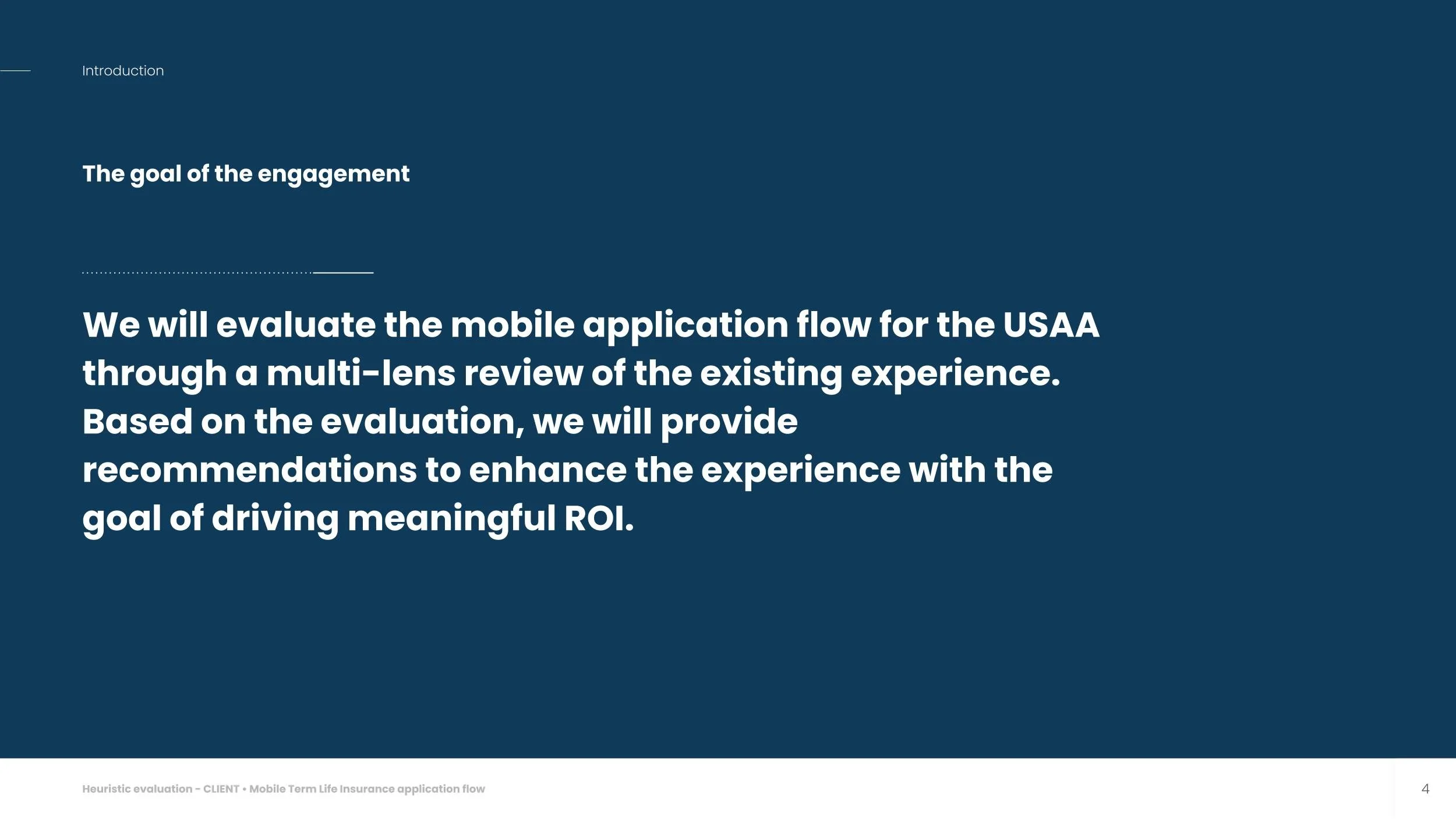
01 — Goal Setting: The engagement's north star, key success factors, and the four evaluation lenses used.
.jpg)
.jpg)
.jpg)
02 — UX/UI Evaluation: Severity summary — 6 Critical, 7 Major, 3 Minor, 1 Irritant issue — assessed against Nielsen Norman Group's 10 Usability Heuristics. Each screen below is the actual audited UI, annotated with the specific issue and recommendation.。 UI 、。
.jpg)
.jpg)
.jpg)
.jpg)
.jpg)
.jpg)
.jpg)
.jpg)
.jpg)
03 — Trauma-Informed Design Evaluation: Five principles — safety, trustworthiness, choice, collaboration, empowerment — applied to the same audited screens.
.jpg)
.jpg)
.jpg)
04 — Opportunities & Recommendations: Effort vs. value matrix prioritizing every UX, UI, and trauma-informed fix.
.jpg)
.jpg)
.jpg)
Deliverables
- UX/UI Evaluation Report
- Strategic Recommendations
- Future Implementation Roadmap
Methods
- Nielsen's 10 Heuristics
- Trauma-Informed Design Assessment
- Severity Rating
Team
- Lead UX (project lead)
- Senior UX Designer
- UI Designer
- Tech Lead
- Project Manager